What Sociophobia Means and How It Relates to Social Anxiety
Sociophobia is an older, plain-language way of talking about a strong fear of social situations. Today, many clinicians and public health resources use the terms social anxiety disorder or social phobia more often. If you searched for sociophobia because you feel tense before conversations, avoid group settings, or wonder whether your shyness has become something more disruptive, the goal is not to label yourself. A useful first step is to understand the pattern, notice where it affects daily life, and use a calm reference point such as a private LSAS self-reflection tool to organize what you are experiencing.

What Sociophobia Means Today
The word sociophobia is usually used to mean fear of social interaction, fear of being watched or judged, or fear of doing something embarrassing in front of others. It overlaps strongly with social anxiety disorder, which describes anxiety and avoidance around social or performance situations that can interfere with relationships, school, work, errands, or everyday routines.
It is also helpful to separate sociophobia from a few nearby terms. Social phobia and social anxiety are often used for the same broad experience. Shyness is a personality tendency or comfort level; it may be mild, situational, and not very disruptive. Anthropophobia is more literally a fear of people themselves, not only social performance or evaluation. Mysophobia is a fear of contamination or germs, so "sociophobia and mysophobia" may overlap only when a person avoids social contact partly because of contamination worries.
In real life, language is messy. Someone may say "fear of socializing phobia name" because they are trying to find the right term for a pattern they already feel. The useful question is less "Which label is perfect?" and more "What situations trigger fear, what do I avoid, and how much is this narrowing my life?"
Social Phobia Examples You Might Recognize
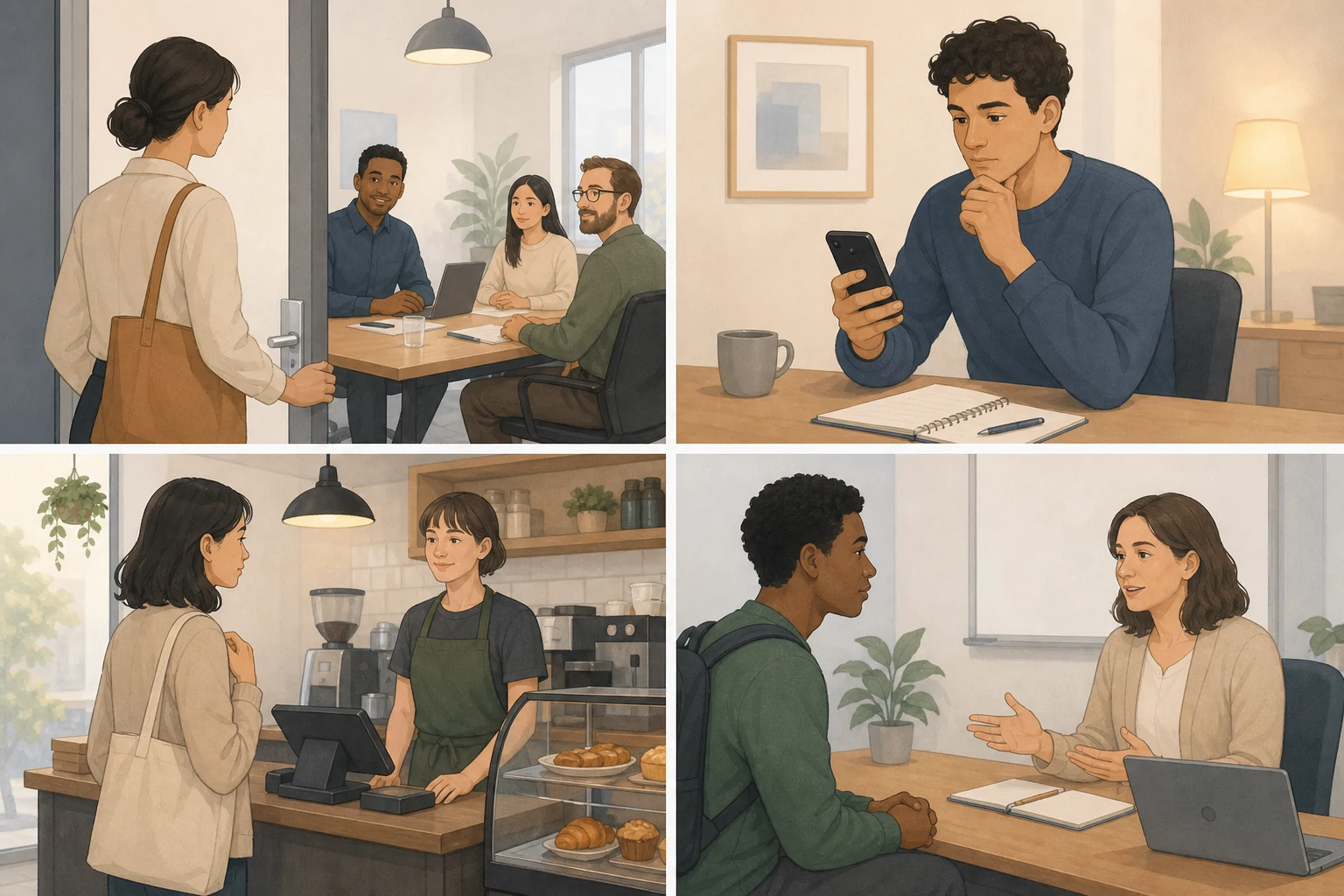
Sociophobia can show up in many small, ordinary moments. One person may feel anxious before speaking in a meeting. Another may avoid eating with coworkers because they worry their hands will shake. Someone else may rehearse a simple phone call for hours, then still delay it because they fear sounding awkward.
Common social phobia examples include:
- avoiding introductions, parties, classes, interviews, or group meals
- feeling watched while writing, eating, walking into a room, or using a public restroom
- fearing that blushing, sweating, shaking, or stumbling over words will be noticed
- replaying conversations afterward and searching for mistakes
- choosing isolation even when you actually want friendship or connection
The pattern often has two parts: fear and avoidance. Fear is the internal alarm. Avoidance is what you do to reduce the alarm quickly, such as canceling plans, staying silent, or leaving early. Avoidance can feel protective in the moment, but over time it may teach the brain that social situations are always unsafe. That is one reason social anxiety help often focuses on small, planned steps rather than sudden pressure.
Mild Social Anxiety Versus Severe Social Anxiety Symptoms
Mild social anxiety may mean you feel uncomfortable in certain situations but still participate with preparation or support. You might dislike presentations, feel nervous around authority figures, or need extra recovery time after busy events. The discomfort is real, but your life may still have flexibility.
Severe social anxiety symptoms tend to be more limiting. They may include intense anticipatory worry, repeated avoidance, physical anxiety symptoms, and significant disruption in school, work, relationships, or daily tasks. You may skip opportunities you care about, avoid needed appointments, or feel unable to build the relationships you want.
Physical signs can include a pounding heart, sweating, trembling, nausea, tight breathing, dizziness, or stomach discomfort. Mental signs can include fear of criticism, fear of embarrassment, harsh self-review, and an assumption that others are noticing every anxious signal. Behavioral signs often include avoiding eye contact, speaking very little, leaving early, or using alcohol or other shortcuts to get through events.
None of these signs prove a condition by themselves. They are clues worth taking seriously, especially when they persist, repeat across settings, or make your world smaller.
Social Anxiety Assessment and the LSAS
Many people search for social anxiety assessment because they want a clearer way to describe their experience. A structured scale can help you move from a vague feeling of "I am bad at socializing" to a more specific map of situations, fear intensity, and avoidance patterns.
The Liebowitz Social Anxiety Scale, often shortened to LSAS, looks at 24 social and performance situations. For each situation, it considers both fear and avoidance. That two-part view matters because some people feel intense anxiety but still push through, while others mainly notice how much they have started to organize life around escape.
LSAS.me is built around a standard LSAS-based anxiety scale that can support private self-reflection. It is best understood as an educational screening-style tool, not a substitute for a qualified mental health professional. If your anxiety feels intense, persistent, or tied to safety concerns, a clinician can provide a fuller evaluation and help you choose suitable support.

What Can Help With Sociophobia
The most useful support plan depends on severity, context, age, health history, and personal preference. Still, several broad approaches appear again and again in public health guidance and clinical education.
CBT, or cognitive behavioral therapy, is commonly used for social anxiety. It helps people notice anxious predictions, test them more realistically, and practice feared situations in a gradual way. Social anxiety CBT is not about forcing yourself to become extroverted. It is about reducing the power of fear so your choices are not controlled by avoidance.
Guided self-help can also be useful, especially for mild or moderate patterns. This may include CBT-based workbooks, journaling, breathing skills, and planned exposure steps. A simple action component is to write down one social situation, the prediction that makes it frightening, the avoidance habit that follows, and one smaller version you could practice.
Medication is sometimes part of care for social anxiety, usually discussed with a qualified health professional. It is not something to choose from an article, and it is not the right path for everyone. If you are searching for social anxiety medication, treat that search as a prompt to speak with a clinician or prescribing professional rather than as a do-it-yourself decision.
Support from trusted people can matter too. A friend, partner, parent, teacher, or manager may be able to reduce unnecessary pressure, help you plan one manageable step, or simply understand why an event feels harder than it looks from the outside.
A Gentle Plan for Overcoming Social Anxiety and Shyness
Many searches phrase the goal as "how to overcome social anxiety and shyness." A gentler and often more realistic goal is to build social comfort gradually. You do not have to become fearless. You are trying to make room for the life you want, one repeatable step at a time.
Try this small framework:
- Name the situation clearly. Instead of "people scare me," write "asking one question in a meeting" or "staying at a gathering for 30 minutes."
- Rate both fear and avoidance. Fear tells you how intense the alarm feels. Avoidance tells you how much the alarm changes your behavior.
- Choose a smaller practice step. If a full party feels too much, start with a ten-minute coffee, a short message, or one planned question.
- Review the result with curiosity. Ask what happened, what you predicted, what was different, and what you want to try next.
- Repeat before making the step harder. Confidence usually grows through repetition, not one dramatic breakthrough.
If anxiety is severe, if you feel stuck in isolation, or if you are also dealing with depression, panic, substance use, or thoughts of self-harm, it is important to involve professional support promptly. Self-help can be a first step, but it should not be the only step when distress is high.

Using Sociophobia as a Starting Point
Sociophobia is a useful search term because it points to a real question: why do social situations feel so threatening, and what can make them easier? The answer usually begins with observation. Notice the settings that trigger anxiety, the symptoms that appear, and the choices you make to avoid discomfort.
From there, you can use a confidential first step for social anxiety patterns to organize what you notice, then decide whether self-help, CBT-informed practice, or professional care fits your situation. The most important shift is from self-criticism to information. You are not trying to prove something is "wrong" with you. You are building a clearer map, so your next step can be smaller, kinder, and more useful.
FAQ
What is the meaning of sociophobia?
Sociophobia generally means a strong fear of social situations, social interaction, or being judged by others. In modern mental health language, people more often use social anxiety disorder or social phobia. The term can still be useful when someone is trying to understand a fear of socializing, but it should not be used as a formal label without professional context.
What is an example of a social phobia?
An example is avoiding a work presentation because you fear your voice will shake and everyone will judge you. Another example is skipping meals with classmates because you worry about being watched while eating. The key pattern is not simple dislike; it is fear plus avoidance that interferes with ordinary life.
What is the difference between social phobia and social anxiety?
In everyday use, social phobia and social anxiety often refer to the same broad problem. Social phobia is an older term, while social anxiety disorder is more common in current health education. Both point to fear of negative judgment in social or performance situations.
Is sociophobia the same as anthropophobia?
Not exactly. Sociophobia usually centers on social situations, performance, embarrassment, or judgment. Anthropophobia is more literally a fear of people themselves. The two can overlap in daily experience, but they are not identical concepts.
Can mild social anxiety improve with self-help?
Mild social anxiety may improve with education, journaling, relaxation skills, gradual practice, and supportive routines. If symptoms persist, spread into more situations, or interfere with important parts of life, professional support can help you build a more tailored plan.
Is CBT useful for social anxiety?
CBT is widely used for social anxiety because it works with both thoughts and behavior. It may include identifying anxious predictions, practicing new responses, and gradually facing feared situations in manageable steps. A therapist can adapt the pace to your needs.
When should someone seek professional help?
Consider professional help if fear and avoidance are persistent, worsening, or limiting school, work, relationships, health care, or daily responsibilities. It is also important to seek help if social anxiety appears alongside depression, panic, substance use, or any concern about personal safety.