Understanding Your LSAS AI Report: Personalized Social Anxiety Insights
You've completed your Liebowitz Social Anxiety Scale (LSAS) assessment and received your score. It’s a crucial first step that gives you a baseline understanding of your social anxiety levels. But what if you could go deeper than just a number? What if you could understand the unique story behind your score?
This is where our AI-powered analysis comes in. At LSAS.me, we believe that true self-awareness comes from personalized insights, not just general labels. Our advanced AI goes beyond standard scoring to transform your answers into a meaningful, actionable report. If you're ready to start this journey, you can always take the free test on our homepage. This guide will explain exactly how our AI report can illuminate your path toward understanding and managing social anxiety.
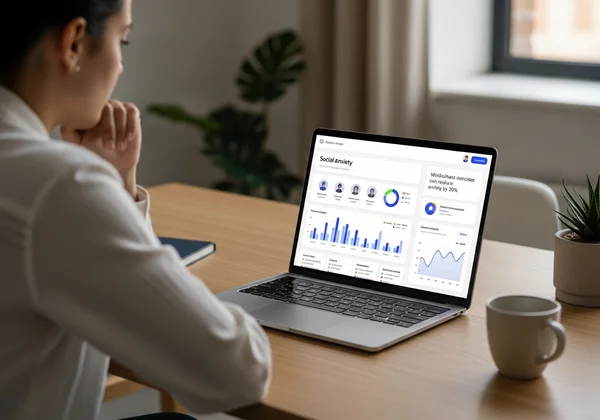
How AI Transforms Your LSAS Responses into Personalized Insights
The idea of artificial intelligence analyzing something as personal as anxiety can seem complex. In reality, our goal is to make the process transparent and helpful. The AI acts as a sophisticated data analyst, looking for connections in your responses that might not be obvious at first glance. It’s designed to turn the "what" (your score) into the "why" (your specific patterns).
This process isn’t about judging your answers. Instead, it’s about providing you with a clearer mirror to see yourself. By identifying subtle themes and trends in your responses to the 24 LSAS questions, the AI provides a level of detail that a simple score cannot offer.
The Pattern Recognition Process: From Raw Data to Meaningful Analysis
When you complete the LSAS test, you provide 48 distinct data points: one for fear and one for avoidance for each of the 24 social situations. Our AI begins its work by looking for patterns across this data. For example, does your fear consistently rate higher in performance-based situations (like giving a speech) compared to interactional ones (like making small talk)?
The AI is trained to recognize these recurring themes. It groups similar scenarios and compares your responses, creating a map of your unique social anxiety landscape. This pattern recognition is the foundation of the personalized insights you receive, turning raw data into a coherent and understandable analysis.
Understanding the Algorithm: How Your LSAS Answers Are Processed
Our algorithm combines data science and psychological profiling principles. When you complete the optional background questions, the AI cross-references this information with your LSAS answers. This process allows for a much more nuanced interpretation of your results. For example, it might identify that your anxiety around authority figures is more pronounced in a professional setting.
The algorithm processes your answers in several steps:
- Scoring and Categorization: It first calculates your standard LSAS fear, avoidance, and total scores.
- Thematic Grouping: It then groups the 24 questions into themes, such as performance anxiety, one-on-one interactions, group settings, and being observed.
- Pattern Identification: The core of the process involves identifying your personal patterns—where your fear and avoidance are highest, lowest, or most mismatched.
- Insight Generation: Finally, it translates these technical findings into clear, easy-to-understand language, forming the key components of your AI-enhanced report.
Key Components of Your AI-Enhanced LSAS Report
A standard score tells you the severity of your social anxiety. An AI-enhanced report from LSAS.me tells you how that anxiety shows up in your daily life. It’s the difference between knowing you have a fever and knowing what’s causing it. Let's explore the main sections of this powerful report.
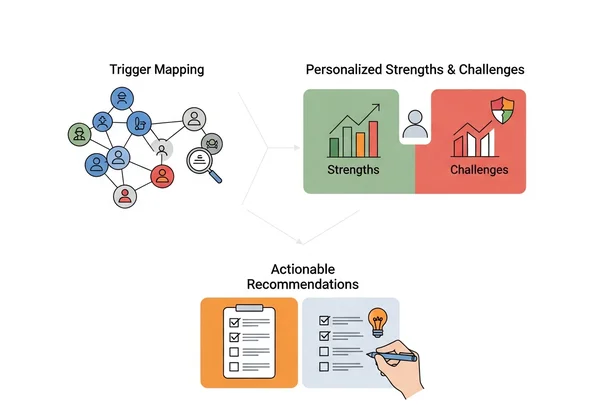
Trigger Mapping: Identifying Your Specific Social Anxiety Hotspots
One of the most valuable features of the AI report is trigger mapping. Rather than a vague feeling of 'being anxious in social situations,' the report provides a clear breakdown of your specific hotspots. For example, it might show that while you're comfortable with close friends, your anxiety spikes when speaking to authority figures.
This specificity is empowering. Knowing your exact triggers allows you to prepare for them, develop targeted coping strategies, or even gently expose yourself to them in a controlled way. It shifts your focus from a vague, overwhelming problem to a set of specific, manageable challenges.
Personalized Strengths and Challenges Analysis
Social anxiety is not a uniform experience. The AI report includes a section dedicated to your personal strengths and challenges. This balanced perspective is essential for growth. You might discover that while initiating conversations is challenging, you actually become quite comfortable once the conversation is flowing.
Recognizing your strengths is just as important as identifying your challenges. It builds confidence and reminds you that social anxiety doesn't define your entire social skill set. This analysis provides a more complete picture, helping you leverage what you do well as you work on the areas that are more difficult.
Actionable Recommendations Tailored to Your Patterns
Information is useful, but action is what creates change. The final key component of your AI report is a set of actionable recommendations. These are not generic tips; they are tailored directly to the patterns identified in your analysis.
For instance, if your report highlights significant avoidance behaviors, the recommendations might focus on small, manageable steps to reduce avoidance. If it identifies a fear of judgment in performance situations, it might suggest cognitive techniques to challenge those specific thoughts. These personalized suggestions serve as a practical starting point for your journey, whether you pursue it through self-help or with a professional therapist. You can get started and see your results today.
Real-World Examples: LSAS AI Report in Action
To truly understand the power of the AI-enhanced report, let's look at a couple of anonymized case studies. These examples illustrate how the analysis can provide breakthrough insights that go far beyond a numerical score.
Disclaimer: The following case studies are based on common patterns and are entirely fictional to protect user privacy.
Case Study 1: From Generalized Social Anxiety to Specific Triggers
"Anna," a 28-year-old graphic designer, received an LSAS score of 75, indicating a moderate to marked level of social anxiety. She felt anxious "all the time" around people and didn't know where to begin.
Her AI report, however, revealed a very specific pattern. Her fear scores were highest in situations involving unstructured social interactions, like "attending a party" or "making small talk." In contrast, her scores were much lower in structured, performance-based situations like "presenting a report to a group." The AI identified her core challenge as a fear of uncertainty in social settings, not a fear of being judged for her performance. This insight allowed Anna to focus her efforts on learning skills for navigating casual conversations, a much more manageable goal than "fixing" her overall anxiety.
Case Study 2: How AI Discovered Hidden Patterns in Avoidance Behaviors
"Ben," a 22-year-old university student, had a moderate LSAS score of 55. He didn't think his anxiety was severe, but he felt his social life was limited. He often turned down invitations, telling himself he was just "too tired."
His AI report uncovered a strong pattern of avoidance specifically related to situations involving the opposite sex. While his fear scores were only slightly elevated in these scenarios, his avoidance scores were near the maximum. The AI highlighted a mismatch: Ben's fear wasn't paralyzing, but his habit of avoidance was preventing him from ever testing his fears. The report's actionable advice centered on breaking this avoidance cycle with very small steps, like simply making eye contact or offering a brief greeting. This tangible, low-stakes starting point felt much more achievable for him.

Empowering Your Journey with Deeper Self-Knowledge
Ultimately, while your LSAS score offers an important snapshot of where you stand with social anxiety right now, our AI-powered analysis reveals the unique story behind those numbers. It confirms that what you're feeling is real and measurable, then transforms that snapshot into a rich, detailed map.
Understanding your specific triggers, recognizing your personal strengths, and receiving actionable recommendations can transform self-assessment into a powerful tool for progress. This deeper self-knowledge empowers you to take control of your journey. It provides clarity, reduces overwhelm, and offers a concrete path forward.
Ready to discover what's behind your LSAS score? The path to understanding your unique social anxiety patterns begins now. Take your free test to begin.
Frequently Asked Questions About LSAS AI Analysis
How accurate is the AI analysis compared to human interpretation?
Our AI analysis is designed to replicate the pattern-recognition skills of a trained professional, but with the ability to process data with speed and consistency. It excels at identifying complex, data-driven patterns that might be missed. However, it is a supportive tool, not a replacement for a therapist's nuanced, empathetic understanding. We always recommend using the report as a starting point for self-reflection or as a helpful document to share with a mental health professional.
Does the AI share my personal data with third parties?
Absolutely not. Your privacy is our top priority. All your test data and personal information are kept strictly confidential and are used solely to generate your personalized report. We are committed to providing a secure and trustworthy environment for your self-exploration. For more details, you can always review our privacy policy on our website.
Can the AI suggest specific treatments for my social anxiety?
Our AI provides actionable recommendations and suggests proven strategies (like those from Cognitive Behavioral Therapy) that are relevant to your specific patterns. However, it does not provide medical advice or suggest specific treatments like medication. The LSAS.me report is an informational tool, not a diagnostic one. For a diagnosis and treatment plan, you must consult a qualified healthcare professional. If you're ready to gather information for that conversation, start your assessment today.
How does the AI ensure cultural sensitivity in its analysis?
This is a vital and ongoing area of development. The Liebowitz Social Anxiety Scale itself has been validated across many cultures. Our AI is designed to focus on the universal patterns of fear and avoidance described in the questions, rather than making assumptions based on cultural backgrounds. As we gather more anonymous data, we continuously refine the algorithm to improve its nuance and sensitivity for our global audience.