Levels of Anxiety: Mild, Moderate, Severe, and Panic Explained
Anxiety is not one single state. It can feel like a useful spark before a presentation, a tightening loop of worry before a social event, or a wave so intense that thinking clearly becomes hard. That is why the levels of anxiety are helpful: they give you a simple way to name intensity without turning your experience into a permanent label.
This guide explains the common four-level model - mild, moderate, severe, and panic - in plain English. It also shows how anxiety levels can appear in social situations, how to reflect on your current level, and when extra support may be wise. If your main concern is social anxiety, a private social anxiety self-check can help you notice patterns of fear and avoidance while keeping the result educational rather than definitive.
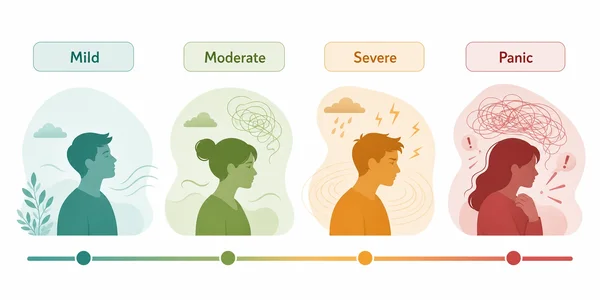
Levels of Anxiety Chart
| Level | Common experience | Thinking and learning | Helpful first response |
|---|---|---|---|
| Mild anxiety | Alert, tense, restless, or more aware than usual | Focus may improve; learning can still happen | Use the energy, breathe slowly, prepare one next step |
| Moderate anxiety | Worry becomes harder to ignore; body symptoms increase | Attention narrows; problem-solving takes more effort | Reduce demands, ground your body, ask for support if needed |
| Severe anxiety | Fear feels overwhelming and may disrupt daily tasks | Clear thinking, learning, and flexible choices become difficult | Step away from triggers when possible and consider professional support |
| Panic level anxiety | Intense fear peaks quickly with strong physical sensations | It may feel hard to process what is happening | Focus on safety, slow grounding, and urgent support if there is risk of harm |
This chart is a guide, not a scorecard. People move between levels depending on sleep, stress, hormones, health conditions, social pressure, workload, trauma reminders, and many other factors. The point is not to perfectly classify every moment. The point is to notice what kind of response your nervous system may need.
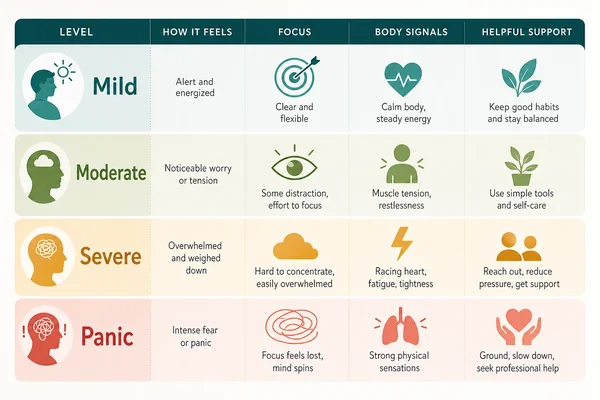
Why Anxiety Levels Are a Spectrum
Anxiety is part of the body's threat-response system. In small doses, it can help you pay attention, rehearse, prepare, and protect yourself. For example, mild anxiety before an exam or meeting may push you to review notes or arrive on time.
The same system becomes less helpful when the intensity keeps rising. Moderate anxiety may narrow your attention so much that you miss context. Severe anxiety may make ordinary tasks feel unmanageable. Panic can make the body feel as if danger is immediate, even when the situation itself may not be life-threatening.
This is why different levels of anxiety require different responses. A small amount of nervous energy may call for preparation. A high level of anxiety may call for slowing down, reducing stimulation, and getting help from another person. The skill is learning to match your response to the level you are actually in.
The 4 Levels of Anxiety in Daily Life
The four-level anxiety model is often associated with Hildegard Peplau's nursing framework: mild, moderate, severe, and panic. These categories are especially useful because they describe both inner experience and functioning.
Mild Anxiety
Mild anxiety is the level many people experience before something important. You may feel alert, slightly tense, restless, or aware of possible mistakes. Your body may show small signs such as fidgeting, shallow breathing, or a tight stomach.
At this level, anxiety can sometimes support learning and performance. You can usually listen, think, plan, and make choices. You may still enjoy the event once it begins. A mild level of anxiety might show up before introducing yourself, joining a group conversation, making a phone call, or speaking in a meeting.
Helpful responses include naming the feeling, preparing a simple plan, breathing out slowly, and focusing on one realistic action. Mild anxiety does not need to be treated as a crisis. It is often a signal that something matters to you.
Moderate Anxiety
Moderate anxiety feels more intrusive. Your attention may narrow toward the worry, and it can take effort to stay present. You might reread the same message several times, rehearse what to say, avoid eye contact, feel sweaty or shaky, or become unusually quiet.
At this level, you can still function, but it may feel strained. You might complete the task while using a lot of mental energy. Learning and problem-solving can happen, but they are less flexible than they would be when you feel calm.
Moderate anxiety often benefits from reducing pressure. Instead of forcing yourself to solve everything at once, try a smaller next step: drink water, slow your breathing, write down the worry, ask a trusted person for perspective, or choose one limited exposure such as staying in the room for five more minutes.
Severe Anxiety
Severe anxiety can significantly interfere with daily functioning. Your mind may lock onto one feared outcome, or it may jump between many worries without settling. You may feel dizzy, nauseated, hot, cold, overwhelmed, or unable to organize your thoughts.
In social situations, severe anxiety may lead to strong avoidance. You might cancel plans repeatedly, leave events early, avoid eating or speaking in front of others, or feel unable to attend school, work, interviews, dates, or group activities. The experience can be exhausting, especially when you also feel ashamed for struggling.
At this level, self-compassion matters. Severe anxiety is not a character flaw. It is a sign that your nervous system is under heavy strain. Practical support, structured coping skills, and a qualified mental health professional can be useful, particularly if the pattern is persistent or limits your life.
Panic Level Anxiety
Panic level anxiety is the most intense level in this model. It may involve a sudden surge of fear with symptoms such as a pounding heart, trembling, shortness of breath, chest tightness, numbness, chills, dizziness, or a feeling of losing control. Some people feel detached from themselves or from the room around them.
Panic level anxiety can be frightening because the body sensations are so strong. During the peak, detailed reasoning may be difficult. Simple grounding tends to work better than complex advice: sit or stand somewhere safe, lengthen your exhale, name five things you can see, feel your feet on the floor, and remind yourself that the wave can rise and fall.
If panic symptoms are new, severe, linked with chest pain, or feel medically concerning, seek medical support. If you might harm yourself or someone else, contact emergency help in your area immediately.
Levels of Social Anxiety and Where LSAS Fits
General levels of anxiety describe intensity. Social anxiety adds a more specific question: where does fear or avoidance show up around being observed, evaluated, rejected, or embarrassed?
For one person, mild social anxiety might mean feeling nervous before small talk but still participating. Moderate social anxiety might mean avoiding optional gatherings or replaying conversations for hours. Severe social anxiety might mean missing classes, meetings, dates, interviews, or friendships because the fear feels too hard to face. Panic level anxiety might appear during a speech, a crowded event, or a situation where escape feels difficult.
The Liebowitz Social Anxiety Scale, or LSAS, looks at both fear and avoidance across common social and performance situations. That makes a structured LSAS social anxiety screening different from a general mood check. It does not replace a formal professional evaluation, but it can help you see whether anxiety is concentrated in certain social patterns: speaking, being watched, meeting unfamiliar people, asserting yourself, or joining groups.
This distinction matters because "high anxiety" is not always the same thing as "high social anxiety." You may feel intense worry about health, finances, school, relationships, or safety. Or you may feel mostly steady until a situation involves scrutiny by other people. Naming the context helps you choose a better next step.

How to Assess Your Anxiety Level in the Moment
You do not need a perfect anxiety levels test to begin reflecting. A brief check-in can tell you whether you are dealing with mild activation, moderate strain, severe disruption, or panic-level intensity.
Ask yourself these questions:
- Can I still take in information, or is my attention locked onto fear?
- Can I make a simple choice, or do all options feel impossible?
- Am I avoiding something important because of anxiety?
- Are my body symptoms uncomfortable but manageable, or do they feel overwhelming?
- Is this feeling temporary and situation-based, or has it been affecting my daily life for weeks?
- Do I feel safe right now?
Your answers can guide the response. If you can think clearly and act, you may be in the mild range. If you are functioning but strained, moderate may fit. If anxiety is disrupting basic tasks, severe may fit. If the fear is surging and your body feels out of control, panic level may fit.
It can also help to rate three areas from 0 to 10: fear intensity, avoidance urge, and daily-life impact. A high fear score with low avoidance may call for calming skills. A high avoidance score may call for gradual exposure or professional guidance. A high life-impact score deserves extra attention even if the anxiety does not look dramatic from the outside.
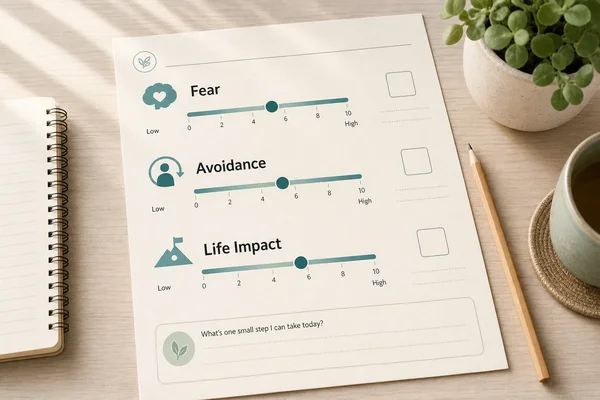
What Helps at Each Anxiety Level
Different levels of anxiety call for different tools. The goal is not to erase every anxious feeling. The goal is to respond in a way that protects your functioning and supports long-term confidence.
For mild anxiety, use preparation and movement. Make a short plan, practice once, stretch, take a walk, or turn nervous energy into action. Mild anxiety often decreases when you begin the task.
For moderate anxiety, simplify the situation. Use slower breathing, reduce multitasking, write down the next step, and give yourself permission to take a brief pause. If social anxiety is involved, choose a realistic exposure rather than an all-or-nothing challenge.
For severe anxiety, prioritize support and structure. You may need to step away from a triggering environment, contact a trusted person, reduce sensory overload, or schedule time with a therapist, counselor, or healthcare provider. Severe anxiety often improves with consistent skills, not with harsh self-pressure.
For panic level anxiety, focus first on safety and grounding. Try to sit somewhere stable, loosen tight clothing if possible, breathe with a longer exhale, and use concrete sensory cues. After the wave passes, consider tracking what happened and discussing it with a professional, especially if panic repeats or changes your behavior.
Across all levels, avoid turning anxiety into a moral judgment. You are not weak for having symptoms. You are gathering information about what your mind and body are asking for.
When High Levels of Anxiety Deserve Extra Support
High levels of anxiety deserve attention when they are intense, persistent, or limiting. Consider reaching out to a qualified professional if anxiety regularly disrupts sleep, work, school, relationships, eating, travel, communication, or daily responsibilities.
Support is also important if anxiety leads you to avoid more and more of your life. Avoidance can feel helpful in the short term because it lowers discomfort quickly. Over time, it can teach the brain that the avoided situation is more dangerous than it really is. This is one reason gradual, supported practice can be so useful for social anxiety.
Get urgent help if you feel at risk of harming yourself or someone else, if you feel unable to stay safe, or if physical symptoms could be a medical emergency. Educational tools are useful for reflection, but they are not a substitute for immediate care in a crisis.
If your anxiety is mainly social, a private screening can be a gentle first step before a deeper conversation. It may give you words for patterns that were previously hard to explain.

Use the Levels of Anxiety as a Starting Point, Not a Label
The levels of anxiety are most useful when they help you respond with more accuracy and less self-criticism. Mild anxiety may ask for preparation. Moderate anxiety may ask for grounding. Severe anxiety may ask for support. Panic level anxiety may ask for safety, simplicity, and follow-up care.
If your anxiety often appears in social or performance situations, you may want to explore how fear and avoidance interact. A confidential LSAS-based reflection can help you organize those patterns privately and decide whether to seek more support. Treat the result as a conversation starter, not a final verdict. Your anxiety level can change, and with the right tools, your choices can become wider than the fear feels in the moment.
FAQ
What are the 4 levels of anxiety?
The common four levels are mild anxiety, moderate anxiety, severe anxiety, and panic level anxiety. Mild anxiety may sharpen focus. Moderate anxiety narrows attention and adds physical tension. Severe anxiety can disrupt daily functioning. Panic level anxiety is the most intense and may include strong body sensations and a feeling of losing control.
What are the 5 stages of anxiety?
There is no single universal five-stage model used for every anxiety experience. Some people describe a pattern such as trigger, rising worry, physical activation, avoidance or coping, and recovery. For practical self-reflection, the four levels of anxiety are often easier to use because they connect intensity with what kind of support may help.
What is considered a high anxiety level?
High anxiety usually means anxiety is no longer just uncomfortable; it is disrupting clear thinking, daily responsibilities, relationships, sleep, or participation in important activities. Severe anxiety and panic level anxiety are high-intensity states. Moderate anxiety can also deserve support if it is frequent or pushes you into repeated avoidance.
Which level of anxiety can enhance learning?
Mild anxiety can sometimes enhance learning because it increases alertness and motivation while you can still think clearly. Moderate anxiety may make learning harder because attention narrows. Severe and panic level anxiety usually interfere with learning because the nervous system is focused on threat rather than flexible thinking.
Are levels of anxiety the same as types of anxiety disorders?
No. Levels describe intensity, while types describe patterns. Common anxiety-related patterns include generalized anxiety, social anxiety, panic attacks, phobias, agoraphobia, separation anxiety, and selective mutism. A person can experience different intensity levels within more than one pattern.
How can I know what level of anxiety I have?
Start by looking at attention, body symptoms, avoidance, and life impact. If you can still think and act, the level may be mild or moderate. If anxiety blocks daily functioning, feels overwhelming, or keeps repeating, consider speaking with a qualified professional. For social situations specifically, an LSAS-style screening can help you reflect on fear and avoidance patterns.